
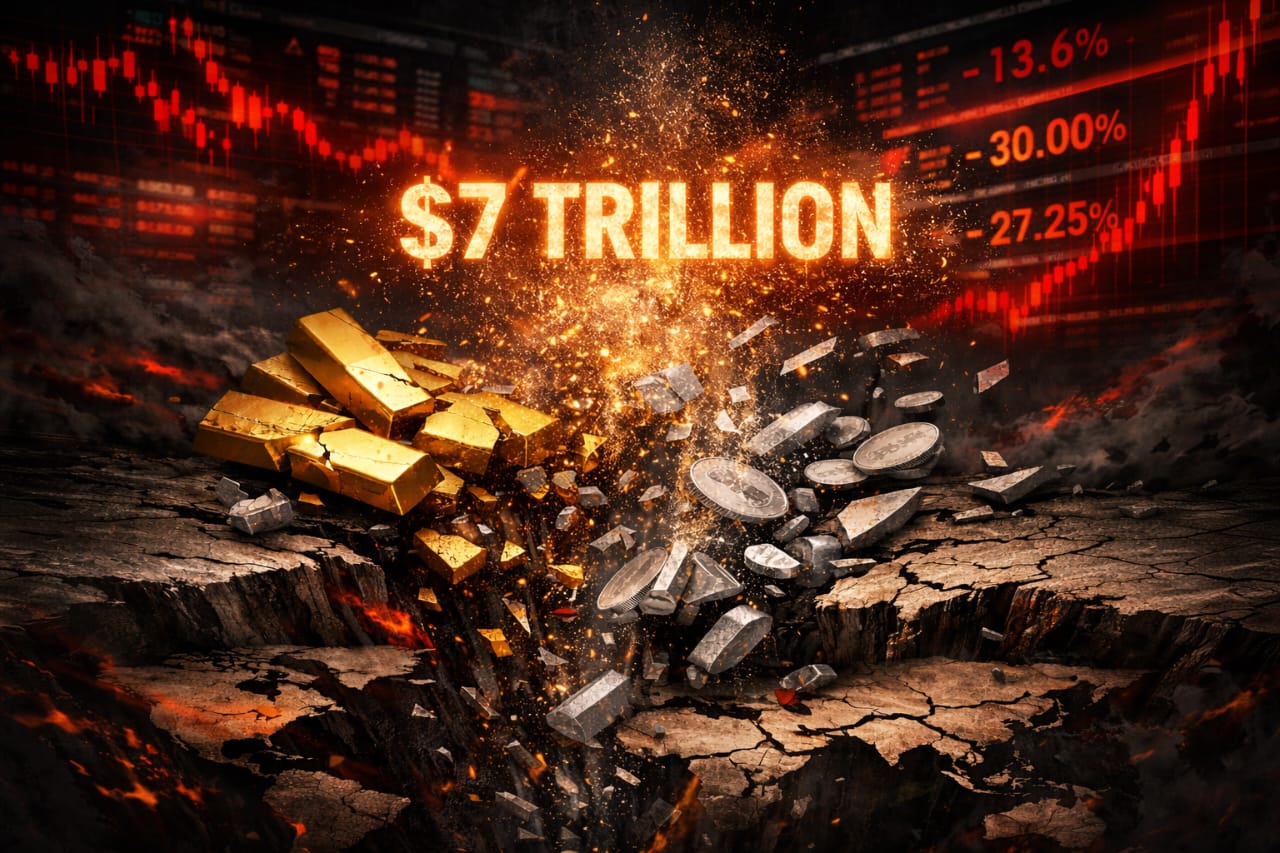
Global precious metals markets are experiencing one of the most violent sell-offs in modern financial history, as over $7 trillion in value disappears in just 36 hours.
What begins as profit-taking quickly turns into a full-scale market rout, sending gold, silver, platinum, and palladium sharply into the red.
Investors who once rush into metals as a safe haven now scramble for exits, as prices collapse at a speed rarely seen before. Market analysts describe the move as historic, not just for its size, but for how quickly confidence unravels across the sector.
Contents
- 1 Gold Suffers Its Biggest Single-Day Collapse Ever
- 2 Silver Sees Historic Intraday Crash Yet Closes The Month Green
- 3 Platinum And Palladium Join The Bloodbath
- 4 Kevin Warsh Fed News Sparks Shift In Market Sentiment
- 5 Over $7 Trillion Vanishes In Just 36 Hours
- 6 What This Means For Investors Going Forward
Gold Suffers Its Biggest Single-Day Collapse Ever
Gold, long viewed as the ultimate store of value, now leads the meltdown.
In a shocking reversal, spot gold plunges from a recent peak of $5,600 to just $4,682 per ounce within 24 to 48 hours, marking the largest single-day drop in gold’s history. The decline erases nearly $5 trillion in market value, sending shockwaves across global trading desks.
Traders point to a sudden shift in risk appetite combined with heavy profit-booking after months of relentless gains. Many institutional players who ride gold’s historic rally now lock in profits aggressively, triggering cascading sell orders.
Market observers highlight how quickly sentiment flips, with bullish momentum evaporating almost overnight. What once looks like a breakout now becomes a brutal correction.
THE LARGEST CRASH IN DECADES.
Over $7 TRILLION has been erased from the precious metals in just 36 hours.
Silver is down 30% and has dropped below $85, wiping out $1.96 trillion.
Gold is down 13.6% and has dropped below $4,900, wiping out $5 trillion.
Platinum is down 27.25%… pic.twitter.com/qMcrCPp8gq
— Bull Theory (@BullTheoryio) January 30, 2026
Silver Sees Historic Intraday Crash Yet Closes The Month Green
While gold dominates headlines, silver delivers some of the wildest price action traders have ever witnessed.
During intraday trading, silver plunges as much as 35%, marking its largest intraday drawdown in history. Prices briefly fall below $70 per ounce, wiping out approximately $1.96 trillion in market value.
In another stunning statistic, spot silver records its biggest daily decline in 46 years, briefly slipping under $75 per ounce before stabilizing.
Yet despite the chaos, silver pulls off a remarkable twist.
By month’s end, silver still closes in the green, up 19%, extending its rally to nine straight months of gains, an extraordinary run rarely seen in commodity markets.
The contrast highlights just how extreme volatility has become: a historic crash occurring inside a broader bullish trend.
This is absolutely insane:
Silver fell as much as -35% during intraday trade today, it's largest intraday drawdown in history.
Yet, silver prices still closed the month GREEN, rising +19%.
This means silver has now risen for 9-STRAIGHT months.
History is an understatement. pic.twitter.com/0rNi2GK6ru
— The Kobeissi Letter (@KobeissiLetter) January 30, 2026
Platinum And Palladium Join The Bloodbath
The sell-off does not stop with gold and silver.
Platinum prices collapse by 27.25%, falling below $2,100 per ounce and erasing roughly $215 billion in value. Meanwhile, palladium plunges 21.5%, dropping under $1,700 per ounce and wiping out another $85 billion.
Both metals had enjoyed strong speculative inflows in recent months as investors bet on industrial demand and supply shortages. But as broader markets turn risk-off, traders dump positions across the entire metals complex.
Analysts describe the move as a synchronized liquidation event, when margin calls, algorithmic trading, and fear accelerate selling far beyond normal corrections.
Once momentum turns negative, bids vanish rapidly.
Kevin Warsh Fed News Sparks Shift In Market Sentiment
One of the major catalysts behind the sudden crash comes from Washington.
News breaks that Kevin Warsh, widely viewed as pro-Bitcoin and market-friendly, becomes the new Federal Reserve Chair, triggering a massive shift in investor positioning.
Markets interpret the move as a potential pivot toward looser monetary conditions, innovation-friendly policies, and alternative assets gaining favor over traditional safe havens like gold.
As expectations shift, capital begins flowing out of precious metals and toward risk assets, especially crypto and equities.
At the same time, months of accumulated profits in metals create the perfect environment for a sharp correction.
Heavy selling meets thin liquidity, and prices cascade lower.
🚨 GOLD CRASH: THE BIGGEST EXPLOSION IN 40 YEARS!
Gold has seen the biggest single-day drop in history over the last 24-48 hours, where spot gold crashed from a peak of $5,600 to $4,682/oz.
The news of Kevin Warsh (pro-Bitcoin) becoming the new Fed Chair and heavy… pic.twitter.com/RICU0MMcZZ
— Crypto Aman (@cryptoamanclub) January 31, 2026
Over $7 Trillion Vanishes In Just 36 Hours
When all losses are tallied, the numbers are staggering:
- Gold: Down 13.6%, wiping out $5 trillion
- Silver: Down 30%, erasing $1.96 trillion
- Platinum: Down 27.25%, losing $215 billion
- Palladium: Down 21.5%, shedding $85 billion
In total, more than $7 trillion disappears from the precious metals market in just 36 hours, one of the largest wealth destructions in commodity history.
Veteran traders compare the event to major financial crashes, noting how quickly leverage unwinds when confidence breaks.
The speed of the decline underscores how modern markets, driven by high-frequency trading and massive institutional flows, can move far faster than in previous decades.
What This Means For Investors Going Forward
Despite the devastation, analysts urge caution against panic selling.
Historically, massive liquidation events often mark turning points rather than long-term collapses. Strong long-term fundamentals, inflation hedging, central bank demand, and industrial usage, still support precious metals over time.
Silver’s ability to finish the month higher despite a historic crash already signals underlying strength.
However, volatility is likely to remain extreme in the near term.
Markets now react not just to economic data, but to political shifts, sentiment swings, and algorithm-driven flows at unprecedented speed.
For investors, the message is clear: precious metals are no longer the slow-moving safe havens of the past, they now trade with the intensity of high-risk assets.
Bottom line:
The precious metals market has just experienced its most violent crash in decades. Over $7 trillion vanishes in less than two days. Gold records its worst drop in history. Silver sees its biggest intraday collapse ever, yet still closes the month higher.
Disclosure: This is not trading or investment advice. Always do your research before buying any cryptocurrency or investing in any services.
Follow us on Twitter @nulltxnews to stay updated with the latest Crypto, NFT, AI, Cybersecurity, Distributed Computing, and Metaverse news!