
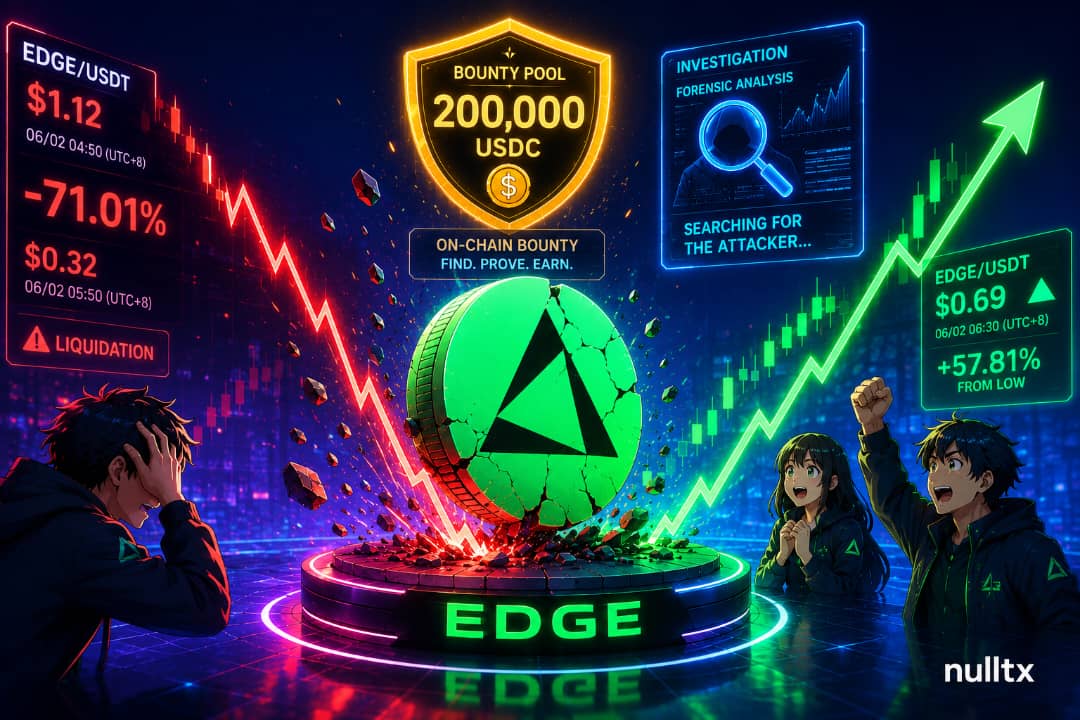
In roughly 60 minutes on the morning of June 2, EDGE, the native token of the EdgeX exchange, fell from approximately $1.12 to $0.32, a collapse of nearly 71% before partially recovering to a range of $0.63 to $0.71.
EdgeX has now published a full incident report, set up a $200,000 USDC bounty pool, and pledged compensation to affected users. But the community is not satisfied, and the accusations keep coming.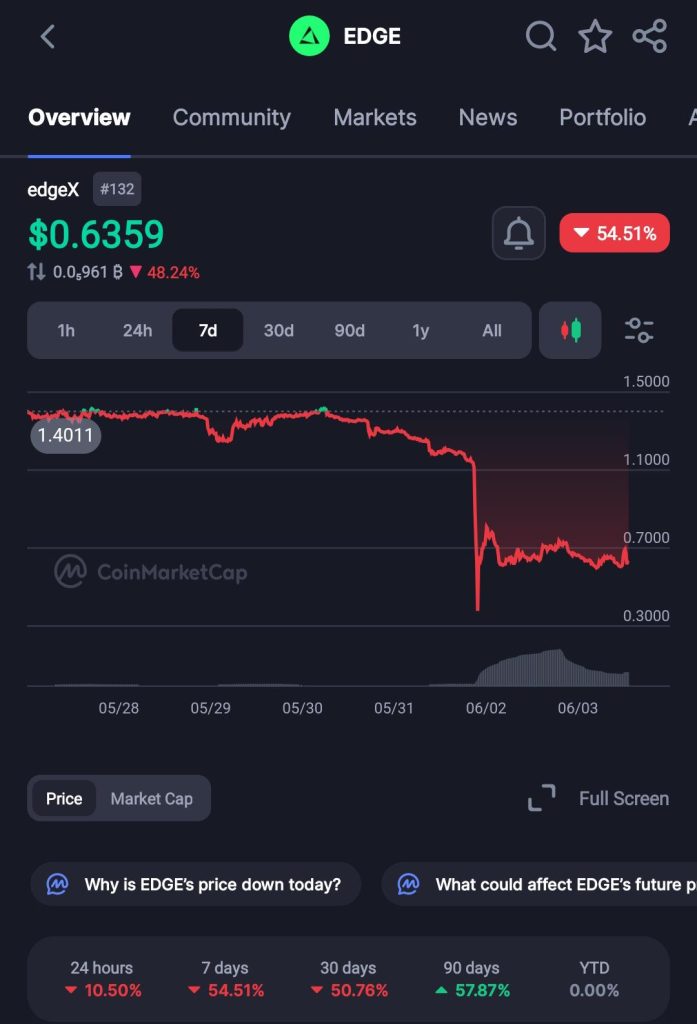
For a project already under scrutiny over a previous price manipulation controversy, the timing and nature of this incident have deepened a trust crisis that a bounty pool alone may not be enough to resolve.
Contents
What The Incident Report Says Happened
EdgeX released its official June 2 incident report laying out the sequence of events and its preliminary findings on what caused the crash. According to the team, the attack targeted the EDGE token price specifically, not the protocol itself. The edgeX platform ran normally throughout the entire incident, and all user assets remained secure at all times. The team’s token allocation, the report states, did not change at any point during the event.
This article sets out our account of the attack on the EDGE token in the early hours of June 2, our team's assessment of what occurred, our position on the matter, and the good will payment plan for affected edgeX users.
We want to state this clearly and on record: edgeX had no… https://t.co/JR975RCeAx
— edgeX🦭 (@edgeX_exchange) June 3, 2026
On the technical side, EdgeX’s preliminary analysis points to a combination of three factors that created the conditions for the crash: thin liquidity on on-chain decentralized exchanges, high-leverage perpetual contracts, and CEX liquidity dynamics.
That combination, a low-liquidity environment, aggressive leveraged positions, and shallow order books across centralized exchanges, created a structure where a targeted push on price could trigger a cascade of liquidations and stop-losses that amplified the move far beyond what organic selling would have produced.
The report is detailed, but it stops short of naming a specific attacker or providing on-chain evidence identifying the source of the manipulation. That gap is precisely where community skepticism is filling in.
The Bounty Pool and Compensation Plan
In a separate announcement, EdgeX confirmed the establishment of a 200,000 USDC on-chain bounty pool tied directly to the incident. The bounty is structured around accountability, the funds are available to anyone who provides verifiable information leading to the identification of the party responsible for the attack.
In the early hours of June 2, 2026, the EDGE token experienced a severe and sudden price dislocation, dropping approximately 71% from around $1.12 to a low of roughly $0.32 within approximately one hour, before recovering and stabilizing in the $0.63–$0.71 range.
We believe this…
— edgeX🦭 (@edgeX_exchange) June 2, 2026
Alongside the bounty, EdgeX says it will issue goodwill compensation to users who suffered actual losses due to EDGE long position liquidations or stop-losses triggered during the incident window, specifically between 04:50 and 06:00 on June 2 (UTC+8). The maximum compensation per individual user is capped at 100,000 USDC.
The move is intended to signal that the team takes the impact on traders seriously. For users who were long EDGE with leverage during that one-hour window, the crash was not a paper loss, it was a forced liquidation event that wiped positions at the worst possible moment. The compensation offer acknowledges that reality directly.
The Team’s Denial And Why The Community Isn’t Buying It
EdgeX has been emphatic in its denial of any internal involvement. The team’s statement leaves no room for ambiguity:
“We want to state this clearly and on record: edgeX had no involvement in this incident. Our team’s token allocations remained entirely unchanged throughout the event, and this is publicly verifiable on-chain.”
The team says it actively requested all relevant CEX platforms to assist in forensic investigations, and that the results of those investigations confirmed no selling activity, no price manipulation, and no misconduct of any kind from the edgeX team. The data, they say, is open and available for the community to verify directly on-chain.
That transparency offer has not landed the way the team may have hoped. Community responses following the incident report have been sharp and largely dismissive. A significant portion of comments across social media and the project’s own channels are calling the team scammers and directly accusing them of orchestrating the crash themselves. The sentiment is not fringe, it represents a majority of visible community reaction, and it reflects a level of distrust that the incident report, however detailed, has not been able to shift.
Why Trust Is The Real Casualty Here
The technical explanation EdgeX offers is plausible. Thin DEX liquidity combined with high-leverage perpetual exposure is a known vulnerability in smaller-cap tokens, and the mechanics of how such a crash could be engineered externally are well understood by anyone who has watched similar events play out across the industry. The protocol remaining operational and user assets staying secure throughout the event are meaningful facts that deserve acknowledgment.
But context matters. This is the second major price controversy surrounding EDGE in a short period. The first incident attracted the attention of on-chain detective ZachXBT, who publicly accused insiders of controlling the token supply with a low float and demanded that the project disclose its market-making agreements and counterparty relationships. Those demands were never fully answered. And now, weeks later, the token has crashed again, this time by 71% in an hour.
For a community already skeptical of the project’s structure, a second dramatic price event within the same news cycle is not something a bounty pool and a well-written incident report can easily overcome. Trust, once broken in public, requires more than transparency pledges to rebuild. It requires time, consistent behavior, and the kind of verifiable accountability that naming counterparties and on-chain evidence of external manipulation would provide.
Disclosure: This is not trading or investment advice. Always do your research before buying any cryptocurrency or investing in any services.
Follow us on Twitter @nulltxnews to stay updated with the latest Crypto, NFT, AI, Cybersecurity, Distributed Computing, and Metaverse news!