
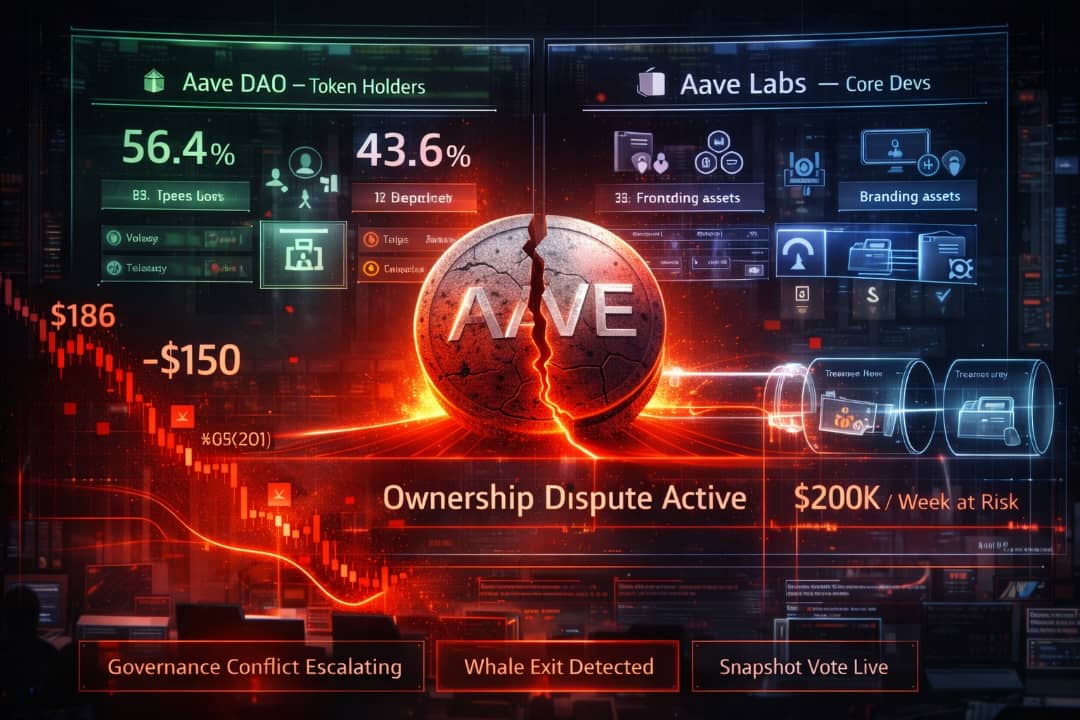
Aave is under pressure. The $AAVE token is down 19.5% on the week, currently trading around $150, as an escalating governance dispute shakes confidence across the protocol.
The selloff is not technical. It is political.
Aave is now caught in a high-stakes conflict between Aave Labs, the centralized development company founded by Stani Kulechov, and factions within the Aave DAO, made up of token holders and elected delegates. The fallout is already visible on the charts. Whales are exiting. Volatility is rising. And governance decisions are moving markets in real time.
According to market data highlighted by CoinGecko, the governance drama has coincided with sharp drawdowns across the week.
$AAVE is down 19.5% this week amid the Aave Labs and Aave DAO dispute.
View chart: https://t.co/PwWtxeUlXh pic.twitter.com/M03YWMmXSp
— CoinGecko (@coingecko) December 23, 2025
At the center of the dispute is a question that cuts to the core of decentralized finance.
Who owns the protocol?
A fundamental DeFi question comes to the surface
Aave has long been viewed as one of DeFi’s most mature protocols. It runs on smart contracts governed by a DAO. Yet much of the user-facing experience, branding, and integrations are maintained by Aave Labs.
That hybrid structure is now under strain.
Token holders believe governance should control economic flows. Founders argue that building, maintaining, and protecting the protocol’s interface requires centralized coordination. The current conflict is forcing both sides to draw lines.
This tension is not unique to Aave. But few protocols are testing it this publicly, or this expensively.
How A Frontend Swap Change Ignited The Dispute
The flashpoint arrives in early December.
Around December 4, 2025, Aave Labs announces a new integration with CoW Swap, replacing the previous swap provider, VeloraDEX, on the official Aave frontend. The stated goal is straightforward. Better pricing. Stronger MEV protection. A smoother experience for users.
On the surface, the upgrade looks positive.
Then questions emerge.
Between December 11 and 12, prominent Aave DAO delegate DeFi_EzR3aL reveals that swap fees generated by the new CoW Swap integration are no longer flowing to the DAO treasury. Instead, they are being routed to wallets controlled by Aave Labs.
That change matters. Historically, similar fees generated roughly $200,000 per week for the DAO. Over a year, that adds up to more than $10 million in protocol revenue.
The reaction is immediate. Community members describe the move as a “stealth privatization” of DAO income.
Marc Zeller, one of Aave’s most influential delegates and a leading voice within the Aave Chan Initiative, publicly calls out the change. His criticism sharpens the debate and pulls it into the spotlight.
Revenue alignment is no longer abstract. It is measurable. And it is now contested.
Governance Escalates From Debate To Confrontation
Between December 17 and 21, tensions boil over.
The governance forum fills with aggressive proposals. Some are incremental. Others are radical.
One idea gains particular attention. A proposal suggesting the DAO seize control of Aave Labs’ intellectual property, including code, branding, and historical revenue. The vision is clear. Make Aave Labs a subsidiary of the DAO.
Former Aave Labs CTO eboadom adds fuel to the discussion. He argues that key brand assets, including domains and trademarks, should belong to the DAO, noting that token holders funded much of Aave’s growth.
The debate is no longer about fees. It is about ownership.
At this stage, the governance process begins to feel adversarial rather than collaborative. Lines harden. Trust erodes. And markets start to notice.
Snapshot Vote Sparks Backlash And Whale Exit
On December 22, the situation takes an unexpected turn.
Stani Kulechov pushes a brand ownership proposal to a Snapshot vote scheduled between December 23 and 26. The proposal is based on a draft originally authored by Ernesto, but the move immediately draws criticism.
Ernesto publicly disapproves. He says his name was used without consent. He calls the timing “disgraceful,” noting that the vote lands during the holidays, when participation is typically low.
Marc Zeller raises additional concerns. He points to procedural interference and potential bias in how the proposal was advanced.
Then the market reacts.
Shortly after the controversy escalates, a whale unloads 230,350 AAVE tokens, worth roughly $37–38 million. The impact is swift. AAVE drops more than 10% within 24 hours.
Governance uncertainty has now translated directly into price action.
As explained by DeFi analysts tracking the situation, this was not panic selling. It was calculated exit risk.
➥ Aave Civil War Recap@aave is currently experiencing intense governance drama
between Aave Labs (the centralized development entity founded by Stani Kulechov) and parts of the Aave DAO ( $AAVE token holders and delegates).The conflict has triggered a 10–20% drop in token… pic.twitter.com/WRngpdTF3S
— Eli5DeFi (@Eli5defi) December 23, 2025
As of now, the Snapshot vote is live.
Sentiment across the Aave community is deeply split. Some view the vote as a healthy step toward decentralization. A chance for token holders to assert control and demand alignment.
Others see it as rushed. A strategic power move by Aave Labs designed to defuse stronger demands and lock in favorable terms before broader participation can mobilize.
Adding another layer, prediction market data reportedly places the odds of the proposal passing at around 25%. For some, that represents a governance signal. For others, a speculative opportunity.
What is clear is that this fight is not really about $10 million per year in swap fees.
It is about whether DeFi protocols can truly be owned by token holders when development companies retain control over interfaces, brands, and revenue funnels.
The outcome at Aave will not stay contained. Other protocols operate under similar hybrid models. They are watching closely.
If token holders prevail, DAOs across DeFi may feel emboldened. If founders retain control, it may reinforce the limits of decentralization in practice.
For now, AAVE trades lower. Governance remains unresolved. And the industry is watching a live stress test of DeFi’s core promise.
Disclosure: This is not trading or investment advice. Always do your research before buying any cryptocurrency or investing in any services.
Follow us on Twitter @nulltxnews to stay updated with the latest Crypto, NFT, AI, Cybersecurity, Distributed Computing, and Metaverse news!