
Aster has published its 2026 H1 roadmap, and the message lands with precision: the team is building with long-term conviction.
After a breakout year in 2025, the project is shifting from rapid feature shipping to core infrastructure, the kind that defines a protocol’s future.
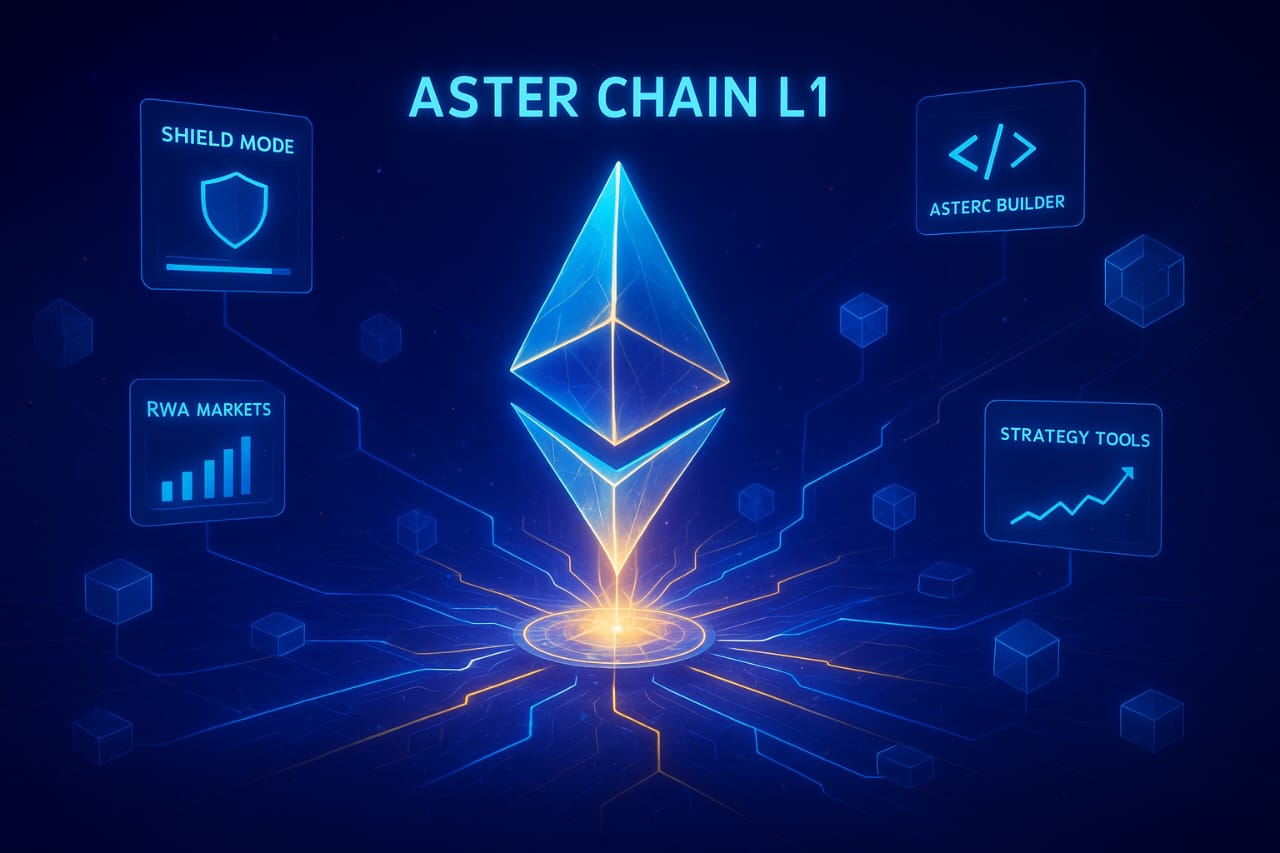
The updated roadmap outlines the next six months of development, culminating in the launch of the Aster Chain L1, native $ASTER staking, and a full builder environment through Aster Code. It’s a transition from product execution to foundational architecture. And for a project that delivered aggressively throughout 2025, the escalation feels both deliberate and transformational.
Contents
- 1 A Massive 2025 Sets the Stage for What Comes Next
- 2 Three Engines Power the New Roadmap
- 3 Shield Mode Arrives First: Private, High-Leverage Trading
- 4 RWA Upgrade and Expanded Stock Perpetual Markets
- 5 Aster Chain Testnet Opens at the End of 2025
- 6 Q1 2026: Aster Chain L1, Aster Code, and Fiat Ramp
- 7 Q2 2026: $ASTER Staking and On-Chain Governance Arrive
- 8 Aster Signals Long-Term Commitment
A Massive 2025 Sets the Stage for What Comes Next
Aster spent most of 2025 proving it can ship, and ship fast.
The team merged Astherus and ApolloX, launched multi-asset margin, released its full mobile app, completed its TGE, and secured listings on major CEXs. Features like Hedge Mode, Trade & Earn, and a consistent buyback program further strengthened the product suite. And through all this, the platform continued adding new markets and expanding liquidity.
It was a year of momentum. A year meant to demonstrate execution. And it did.
Now, Aster is moving into a different phase entirely, one centered not on proving capability, but on building the long-term engines that a lasting network requires.
🗺️ 2026 H1 Roadmap Reveal: What's Next for Aster
2025 was about proving Aster can ship: we merged Astherus & ApolloX, launched multi-asset margin, released our mobile app, completed TGE, listed on major CEXs, and introduced features like Hedge Mode, Trade & Earn, and our buyback… pic.twitter.com/It8ZAigvKc
— Aster (@Aster_DEX) December 4, 2025
Three Engines Power the New Roadmap
The new roadmap is built around three reinforcing pillars:
- Infrastructure
- Token Utility
- Ecosystem & Community
These engines feed into one another, forming a cycle where the platform grows, the token gains use cases, and the community drives adoption. It’s a shift away from a product-first cycle and into a network-first model, a necessary pivot for any project aiming to become a long-term player in decentralized trading.
The vision is clear. Aster states it plainly:
“We’re not building another trading venue. We’re building a network that grows with its users.”
Shield Mode Arrives First: Private, High-Leverage Trading
The first milestone lands in early December 2025: Shield Mode.
Shield Mode is designed for private, high-leverage execution. Traders gain the ability to take large or sensitive positions without exposing strategies or order flow. The feature introduces enhanced anonymity at scale, coupled with execution precision.
Alongside Shield Mode, Aster rolls out TWAP strategy orders, giving traders new ways to automate large-scale execution over time. These features signal Aster’s continued investment in advanced tools for active traders, foundational components for any serious trading ecosystem.
RWA Upgrade and Expanded Stock Perpetual Markets
By mid-December 2025, the project pushes its RWA upgrade, expanding deeper into real-world assets and stock perpetual markets. The expansion introduces broader equity coverage, more liquidity, and tighter integration between traditional and crypto-native trading products.
This is a continuation of Aster’s push into multi-asset margin and cross-market infrastructure. The upgrade gives traders more instruments, more exposure, and a more robust environment for building complex strategies.
RWA markets remain one of crypto’s fastest-growing sectors. Aster is positioning itself early, a strategic move heading into 2026.
Aster Chain Testnet Opens at the End of 2025
The biggest step of the year arrives at the end of December 2025:
- the launch of the Aster Chain testnet.
The testnet invites the community to begin experimenting directly with the coming Layer 1 chain. Developers gain access to the environment ahead of the mainnet launch, while users test performance, features, and early applications.
The testnet marks the moment Aster shifts from a trading platform to a network architecture project. It sets the stage for everything to follow in 2026.
Q1 2026: Aster Chain L1, Aster Code, and Fiat Ramp
The roadmap’s most important milestone lands in Q1 2026:
- the launch of Aster Chain L1.
The new chain serves as the backbone of Aster’s ecosystem. It introduces native programmability, application expansion, and deeper control over performance and cost. This is paired with the release of Aster Code, a full builder environment designed for developers to build, deploy, and grow applications on top of the network.
Q1 also delivers a critical step for mainstream accessibility: fiat on/off-ramp support. This creates a frictionless entry point into the Aster ecosystem, enabling a direct flow between traditional finance and on-chain activity.
With these additions, Aster completes its transition into a multi-layer network with developer tooling and direct user onboarding infrastructure.
Q2 2026: $ASTER Staking and On-Chain Governance Arrive
By Q2 2026, Aster unlocks the next phase of token utility.
The network will introduce $ASTER staking, allowing holders to participate directly in network security and earn yields tied to network performance. On-chain governance launches alongside staking, giving token holders a direct role in network-level decisions, upgrades, and policy setting.
Aster also plans to launch smart-money tracking tools that let users follow top traders on-chain, a feature aimed at deepening community engagement and elevating user strategy.
These additions complete the token’s transition from a trading asset to a core component of the network’s economic engine.
Aster Signals Long-Term Commitment
Aster’s 2026 roadmap reflects confidence, not just in product execution, but in vision. The team is moving beyond rapid shipping and into deliberate ecosystem building. Infrastructure. Token value. Community expansion. Network effects.
The message is consistent throughout the roadmap and echoed again in Aster’s public announcement:
“Thank you for being part of this journey.”
Aster isn’t positioning itself as another trading venue. It’s building a durable network. One that grows with its users, supports builders, strengthens its token economy, and expands its environment of tools, features, and markets.
- 2025 was the year Aster proved it can move fast.
- 2026 is the year it proves it can build something that lasts.
Disclosure: This is not trading or investment advice. Always do your research before buying any cryptocurrency or investing in any services.
Follow us on Twitter @nulltxnews to stay updated with the latest Crypto, NFT, AI, Cybersecurity, Distributed Computing, and Metaverse news!