
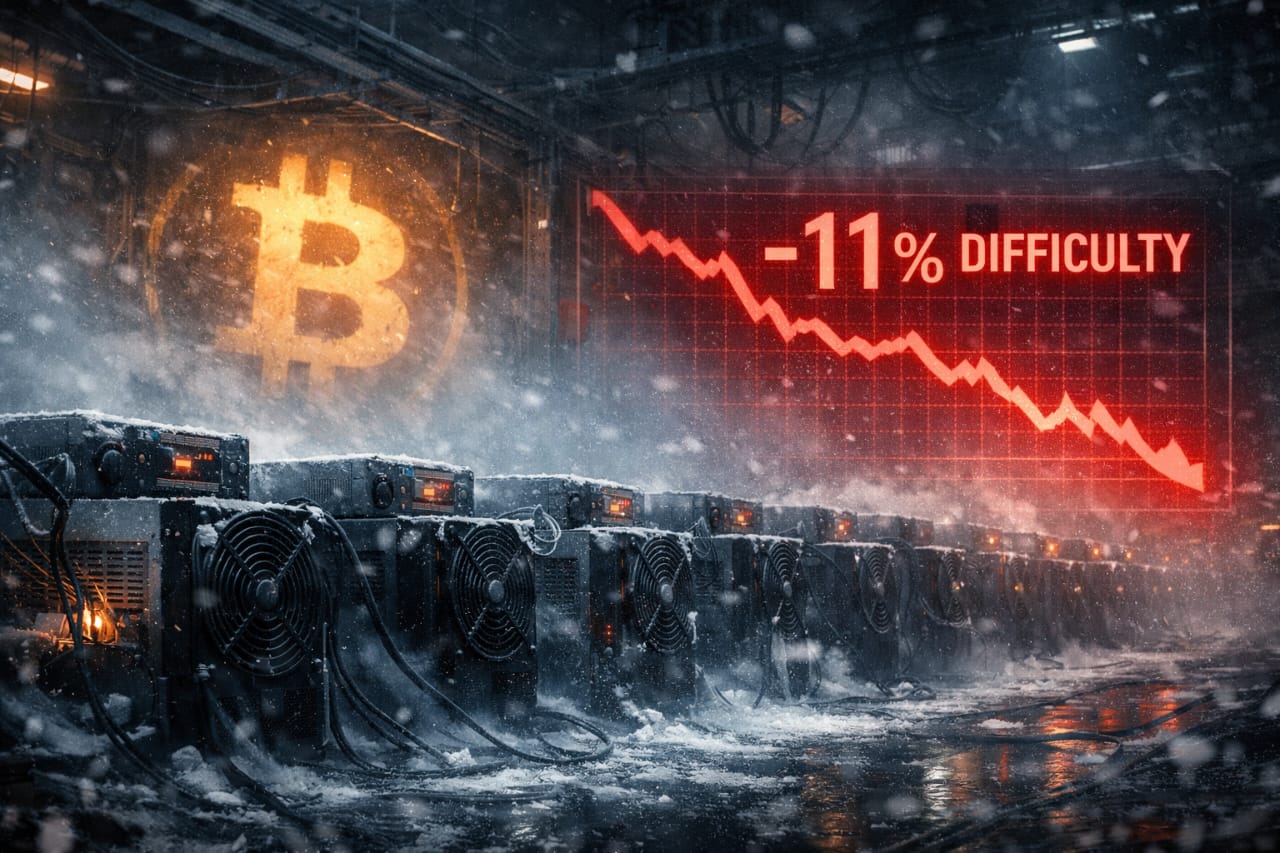
Bitcoin’s mining network has recorded a sharp 11% difficulty adjustment downward, marking the largest negative change since China’s sweeping mining ban in 2021 and ranking among the biggest drops in Bitcoin’s history.
The adjustment reflects a sudden and meaningful contraction in network participation, as miners across multiple regions were forced offline amid a combination of falling prices and extreme weather conditions.
The development was highlighted by Crypto Miners in a post on X, drawing attention to the scale and rarity of the move.
Bitcoin mining just took a big hit#Bitcoin’s mining difficulty dropped 11%, the largest negative adjustment since China’s mining ban in 2021 and one of the biggest ever.
Hashrate is down roughly 20% over the past month, hit by a sharp $BTC price drawdown and widespread miner… pic.twitter.com/XwlibjjiLR
— Crypto Miners (@CryptoMiners_Co) February 8, 2026
Difficulty adjustments are designed to keep Bitcoin’s block production stable at roughly one block every ten minutes. When large amounts of hashpower leave the network, difficulty falls to compensate. An 11% reduction signals that the disruption was not incremental, it was abrupt, widespread, and significant.
Contents
Hashrate Drops As Miners Power Down
Behind the difficulty shock is a sharp decline in hashrate. Over the past month, Bitcoin’s total computational power has fallen by roughly 20%, as miners responded to mounting operational pressure.
A major contributor to this drop was Winter Storm Fern in the United States, which caused widespread power outages and forced temporary shutdowns across several mining hubs. Extreme cold weather strained energy grids, leading to curtailed operations and emergency shutdowns to avoid equipment damage.
At the same time, the recent Bitcoin price drawdown significantly reduced mining revenue, pushing many operators to turn off machines that were no longer economically viable. Some estimates suggest that as much as 200 exahashes per second (EH/s) went offline during this period, a massive reduction in network capacity.
This combination of environmental disruption and financial stress created a perfect storm, accelerating miner capitulation and driving one of the steepest short-term hashrate declines in recent years.
Miner Economics Hit All-Time Lows
The difficulty drop comes as miner economics reach historically challenging levels.
Hashprice, a key metric measuring daily revenue per unit of hashpower, has fallen to an all-time low near $33 per petahash per day. At these levels, profitability margins are razor-thin, or nonexistent, for much of the global mining fleet.
Older-generation machines are now firmly underwater, unable to cover electricity and operational costs unless power is exceptionally cheap. Only the newest and most efficient ASIC rigs remain comfortably profitable under current conditions.
This dynamic has accelerated a natural selection process within the mining industry. Operators with outdated hardware or high energy costs are being forced offline, while well-capitalized miners with access to modern equipment and favorable power contracts are better positioned to survive.
The pressure is not theoretical. For many miners, continuing to operate at current hashprice levels means absorbing daily losses in the hope of future price recovery.
Difficulty Adjustment Offers Temporary Relief
The 11% difficulty reduction provides immediate, though conditional, relief for miners who remain online.
With fewer competitors securing blocks, the remaining hashpower earns a larger share of network rewards. In practical terms, miners still operating can now generate more Bitcoin per unit of compute than before the adjustment.
However, this relief is not a cure-all.
Lower difficulty only improves profitability if Bitcoin’s price stabilizes or recovers. If prices continue to fall, even reduced difficulty may not be enough to offset declining revenue. Energy costs, debt obligations, and hosting fees still apply regardless of network conditions.
For miners that survived the recent shakeout, the adjustment buys time. Whether that time translates into recovery depends almost entirely on market direction over the coming weeks.
A Cycle Echoing Past Mining Stress Events
This moment draws inevitable comparisons to previous periods of mining stress, particularly the aftermath of China’s mining ban in 2021.
Back then, hashpower dropped dramatically as miners unplugged en masse and relocated across borders. Difficulty adjustments followed, creating opportunities for miners who stayed online or resumed operations early.
While the causes differ, policy shock then, economic and environmental stress now, the mechanics are similar. Sudden exits compress difficulty, temporarily improving conditions for those who remain.
Historically, such periods have marked transition phases rather than endpoints. Hashrate eventually recovers as conditions stabilize, new hardware comes online, and price incentives return.
The current downturn fits that pattern, though the timeline remains uncertain.
What Happens Next Depends On Bitcoin Price
Ultimately, the impact of this historic difficulty drop hinges on where Bitcoin’s price goes next.
If price stabilizes or rebounds, the combination of lower difficulty and reduced competition could restore profitability faster than many expect. This would encourage sidelined miners to re-enter the network, gradually pushing difficulty higher again.
If price weakness persists, further miner capitulation is possible. More shutdowns would reduce hashrate again, potentially triggering additional difficulty drops, but at the cost of industry consolidation and financial strain.
What remains clear is that Bitcoin’s mining ecosystem is once again proving its adaptability. The protocol adjusts automatically, absorbing shocks without human intervention and maintaining block production even during severe disruptions.
The 11% difficulty drop is not just a statistic. It is a reflection of real-world pressures, weather, markets, and economics, colliding with a global, decentralized system.
And as always in Bitcoin mining, survival belongs to those who can endure volatility long enough to reach the next cycle.
Disclosure: This is not trading or investment advice. Always do your research before buying any cryptocurrency or investing in any services.
Follow us on Twitter @nulltxnews to stay updated with the latest Crypto, NFT, AI, Cybersecurity, Distributed Computing, and Metaverse news!