
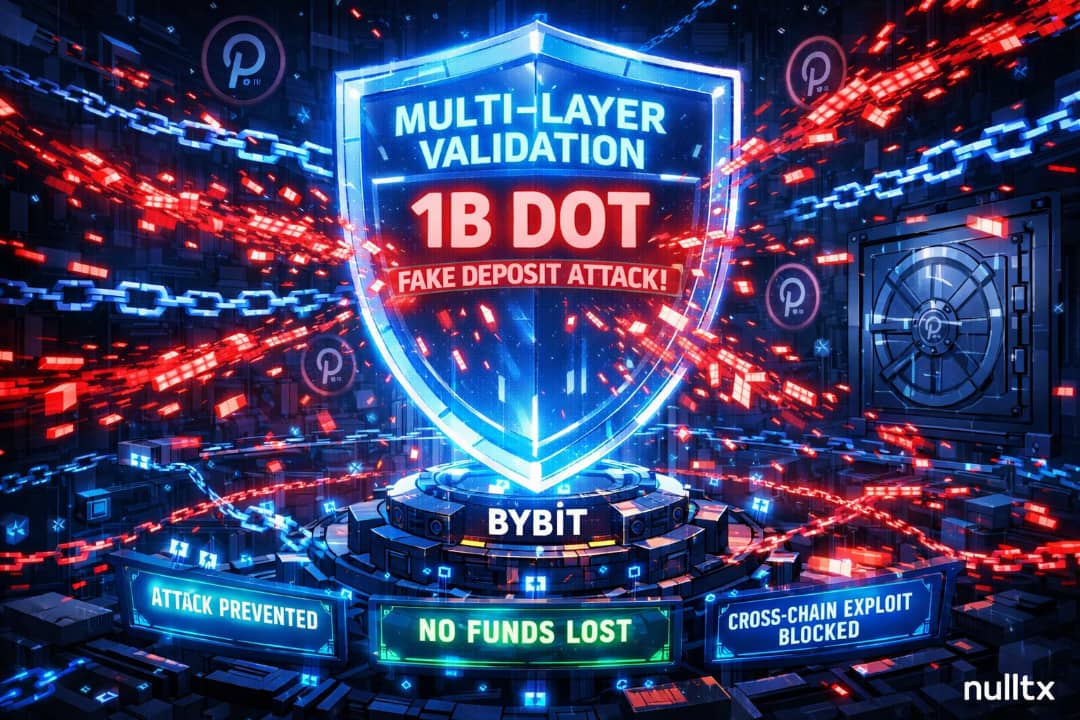
Cryptocurrency exchange Bybit has successfully detected a large-scale coordinated attack on the deposit systems of several blockchains.
The order would ensure that accordingly user funds remain safe while over 1 billion Dot were used fraudulently to credit the service. This is worth over $1.3B at this time as per exchange announcement.
This incident is a wake up call that sophisticated exploits are now targeting exchange infrastructure as well as vulnerabilities in smart contracts. It highlights how the tactics of attackers have also evolved with security mechanisms of cryptocurrency seeing greater maturity.
Contents
An Orchestrated Attack on Exchange Mechanics
The exchange stressed that none of the attackers sought to hack wallets or directly steal funds. Instead, they zeroed in on a less obvious vulnerability, how exchanges process and verify deposits.
The attackers targeted only certain bank features to trick the system into believing fraudulent deposits were legitimate transactions. They would have accrued credits on the accounts while no real assets were moved had their scheme been successful.
For the exploit execution, the attacker used a combination of batched and multi-step transactions flows. These techniques were designed to mimic blockchain behavior, giving the impression that money had been transferred (without truly adding to net balance).
It is not a direct manipulation of systems but rather an obfuscation from within (of existing processes).
How the Attack Was Intended to Work
The exploit attempted to imitate legitimate deposits using carefully crafted transaction patterns. The attackers carried out a series of steps to make it appear as if the deposits were pending.
In typical deposit processes, exchanges ensure that assets have been “sent” and confirmed on-chain before crediting a user’s account. By using this method of verification, the attackers tried to broadcast transactions that looked like they went through but with no real gain from it.
As a result, such an approach holds serious dangers as it is contrary to underlying assumptions in the system. Without a strong enough validation layer, an exchange could mistakenly onboard users on false pretenses.
Luckily, in this case this attack did not go as far as causing damages.
Over $1 Billion in Fake Deposits Prevented by Real-Time Detection
Real-time internal monitoring systems triggered by Bybit stopped fraudulent credits from being processed altogether. Instead of relying on low-level confirmations, the exchange says this success is thanks to the additional checks that they run at higher levels. This is through their multi-layer validation framework.
A prominent feature of this architecture is ownership-aware tracking, especially for account-based blockchains such as Solana. Not just the transactions getting confirmed, but the verification of true ownership and fund movements also governed by an extensive pattern.
Using layered validation, the team recognized discrepancies in transaction flows and successfully neutralized the attack.
The numbers are staggering; if the API exploit had been successful. Then, over 1 billion DOT (about $1.3 billion at current prices) would have been wrongly credited.
Timing Raises Industry-Wide Concerns
The attempted attack comes amid a string of major incidents that have raised alert level across the entire cryptocurrency industry. ByBit itself has been heavily hacked in the past when it was penetrated following Bitfinex 2025 hack, leading to losses of $1.5 billion.
And the Drift Protocol exploit more recently resulted in ~$280 million going south. Thereby, indicating vulnerabilities on both centralized and decentralized platforms.
This most recent attempt reiterates the idea that attackers are constantly refining their tactics. Instead of regular exploits, they rely on edge cases and operational mechanics within the platforms.
Although the successful thwart of this attack is good news, it is a sobering reminder of the stakes.
An Emergent Exchange-Level Threat
What sets this incident apart is the attempted nature of the attack. Instead of going after smart contracts or private keys, the attackers wanted to take control over the deposit logic, a subtle but important part of any exchange’s operations.
As exchanges are becoming more sophisticated, they also support a larger number of blockchains and edge cases are growing exponentially. Each new integration comes with its own transaction behaviors and attack vectors.
As systems become increasingly adept in doing so, attackers gain the space to innovate and devise new loopholes that exploit non-traditional transaction flows.
The fact that bybit is able to detect and mitigate this specific exploit pleads for a better attunement of exchanges to the threats already posed towards them, but also hints that they will be more frequent.
Implications for Users & The Market
For users, the immediate result is a good one: not money was lost, and the attack was stopped before any real damage went down. This is a great win in the war to come of security practitioners against the attackers as both learn from each other on how to improve security.
But it also highlights the level of trust users have in centralized systems. Exchanges facilitate market access and provide liquidity, but they also take on the role of ensuring transactional integrity.
For the broader market, this event illustrates an important narrative: security is no longer just about protecting assets; it is also about making sure that systems do what they are supposed to do at all times.
As attackers “innovate” continuously, the need for stronger defenses is becoming increasingly necessary. This progress requires an update of the technical infrastructures for sure, but also a fair look at how to deal with edge cases and abnormal behaviors.
In this case, due to Bybit’s ability to stay ahead of the curve. But the scale and sophistication of this effort indicate that it is unlikely to be the last such attack.
Disclosure: This is not trading or investment advice. Always do your research before buying any cryptocurrency or investing in any services.
Follow us on Twitter @nulltxnews to stay updated with the latest Crypto, NFT, AI, Cybersecurity, Distributed Computing, and Metaverse news!