
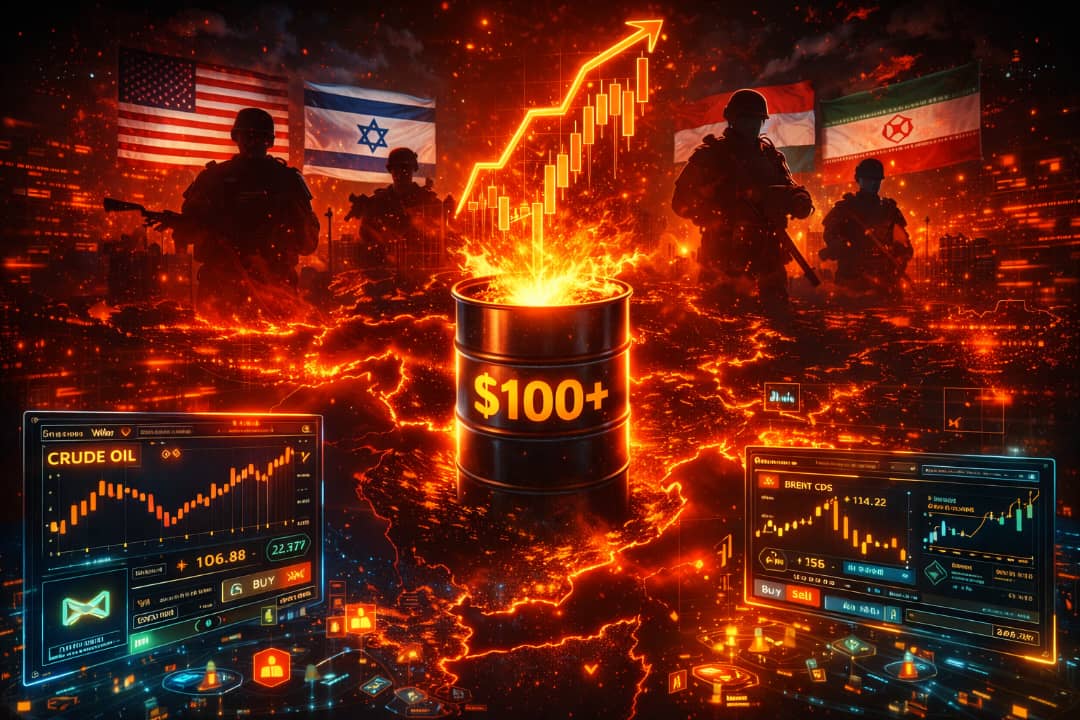
Global energy markets are once again under pressure as oil prices surge past a critical milestone.
Over the weekend, crude oil briefly crossed $100 per barrel for the first time since 2022, sending shockwaves through traditional markets and raising fresh concerns about global supply disruptions.
The spike comes amid escalating conflict involving the United States, Israel, and Iran. As the war entered its second week, traders reacted quickly to fears that the fighting could threaten a large share of global oil supply. At one point on Sunday, Brent crude climbed more than 20%, reaching roughly $114 per barrel before easing slightly.
The sudden surge highlights how geopolitical tensions can rapidly ripple through global energy markets. While traditional financial markets remain closed on weekends, digital platforms and crypto-based trading venues have increasingly become places where price discovery continues around the clock.
Oil Crosses $100 a Barrel – First Time Since 2022
The U.S.-Israeli war on Iran has sent global energy markets into a tailspin. Brent crude surged more than 20% on Sunday, at one point topping $114 a barrel, as the conflict entered its second week with no end in sight.
Gas… pic.twitter.com/HNZkKGngL3
— Top 7 Crypto | Analytics & Alpha (@top7ico) March 9, 2026
Contents
The sharp move in oil prices is tied directly to supply fears surrounding the ongoing conflict with Iran. Analysts estimate that the war has already disrupted around 20% of global oil supply, a figure that underscores the scale of the shock hitting energy markets.
To put that number into perspective, the disruption is more than double the previous record set during the Suez Crisis, which had long been considered one of the most severe energy supply disruptions in modern history.
BREAKING: President Trump is reviewing a "set of options" to lower oil prices as soon as today amid their historic surge, per Reuters.
Details include:
1. Options include restricting US exports, intervening in oil futures markets, and waiving some federal taxes
2. Trump could…
— The Kobeissi Letter (@KobeissiLetter) March 9, 2026
Iran sits in one of the world’s most strategically important energy corridors, and any instability in the region tends to trigger immediate market reactions. Traders are particularly focused on the Strait of Hormuz, a narrow waterway through which a significant portion of global oil shipments passes.
If the strait remains blocked or heavily disrupted, analysts warn that oil prices could climb even higher in the coming weeks.
Some projections suggest that crude could reach $150 per barrel by the end of March if the situation fails to stabilize.
Gasoline Prices Jump For Consumers
The spike in crude prices is already beginning to show up at the pump.
In the United States, gasoline prices have risen sharply over the past week. Average prices for drivers have climbed about 50 cents per gallon, moving from just under $3 to around $3.45.
For households and businesses, such increases can quickly translate into higher transportation costs and broader inflation pressures across the economy.
Energy prices tend to ripple through multiple sectors, affecting everything from logistics and manufacturing to food prices and airline operations. As a result, policymakers are closely watching the situation and weighing potential responses.
Despite the volatility, U.S. oil prices have since pulled back slightly and are currently trading below $95 per barrel, though markets remain extremely sensitive to new developments in the conflict.
Trump Defends Rising Prices As Necessary For Security
Amid the market turbulence, Donald Trump addressed the surge in energy prices through a post on Truth Social.
Responding to criticism over the rising costs, Trump suggested that the economic impact should be viewed in the broader context of global security.
According to the post, the increase in oil prices represents “a very small price to pay for U.S.A., and World, Safety and Peace.”
He added that “only fools would think differently.”
The comment reflects the political balancing act surrounding energy prices during periods of geopolitical conflict. While higher prices can signal tighter supply and increased strategic pressure on adversaries, they also place financial strain on consumers and businesses.
The administration now faces the challenge of managing both the geopolitical situation abroad and its economic consequences at home.
Crypto Platforms Become Weekend Oil Price Venues
One of the more unusual developments during the latest surge is where price discovery took place.
Traditional commodity markets typically close on weekends, leaving a gap in trading activity when major geopolitical events unfold outside normal market hours. But cryptocurrency-based platforms operate continuously, allowing traders to react in real time.
During the escalation of the Iran conflict, several decentralized trading platforms emerged as 24/7 venues for oil price speculation and price discovery.
Platforms such as Hyperliquid, Trade.xyz, Ostium Labs, and Lighter allowed traders to respond to market developments while traditional exchanges remained closed.
These platforms operate entirely on-chain and allow users to maintain self-custody of their assets while trading derivatives tied to real-world commodities.
The episode highlights a growing trend in financial markets: crypto infrastructure increasingly serves as a parallel venue for global price discovery when legacy systems are offline.
White House Considers Emergency Measures To Ease Prices
Meanwhile, policymakers in Washington are actively reviewing possible measures to curb the surge in oil prices.
According to reports cited by Reuters, President Trump is currently reviewing a range of policy options aimed at lowering energy costs as soon as possible.
Among the measures under discussion are restrictions on U.S. oil exports, intervention in oil futures markets, and temporary waivers of certain federal fuel taxes.
Another potential step involves lifting some requirements under the Jones Act, which mandates that domestic fuel shipments move only on U.S.-flagged vessels. Removing or relaxing this rule could allow fuel to move more freely between U.S. ports.
Officials inside the White House are reportedly concerned that the surge in oil prices could hurt American businesses and consumers if the trend continues.
There is also a political dimension to the issue. Rising energy costs often become a central topic during election cycles, and the administration is said to be weighing the potential impact of higher fuel prices on upcoming mid-term elections.
Markets Brace For Continued Volatility
Even with the slight pullback in U.S. oil prices, markets remain on edge.
Energy traders are closely monitoring developments in the Middle East, particularly any updates regarding shipping routes through the Strait of Hormuz or further escalation in the conflict.
If supply disruptions persist, oil prices could continue climbing. On the other hand, any diplomatic breakthrough or reopening of key shipping routes could quickly reverse some of the recent gains.
For now, the surge past $100 per barrel serves as a reminder of how quickly geopolitical tensions can reshape global energy markets.
And as traditional markets pause during off-hours, the latest episode also shows how crypto-based trading platforms are beginning to fill the gaps, offering round-the-clock venues where traders can react instantly to global events.
Disclosure: This is not trading or investment advice. Always do your research before buying any cryptocurrency or investing in any services.
Follow us on Twitter @nulltxnews to stay updated with the latest Crypto, NFT, AI, Cybersecurity, Distributed Computing, and Metaverse news!