
Bitcoin mining giant MARA appears to be rebuilding its Bitcoin treasury after one of its most aggressive selling quarters on record.
According to on-chain analytics platform Lookonchain, the company recently acquired 1,000 BTC worth approximately $66.7 million through institutional crypto prime broker FalconX, a move that is already sparking fresh conversation across the market.
The timing catches many off guard. Just weeks after winding down a massive liquidation cycle, MARA is stepping back in, and traders are paying close attention.
Contents
A Quiet Accumulation After a Loud Exit
MARA’s Q1 2026 numbers told a different story. The company sold 20,880 BTC, worth roughly $1.5 billion, at an average price of $70,137 per coin, according to Lookonchain data. That kind of volume doesn’t go unnoticed, and at the time, the sales contributed to broader selling pressure across the Bitcoin market.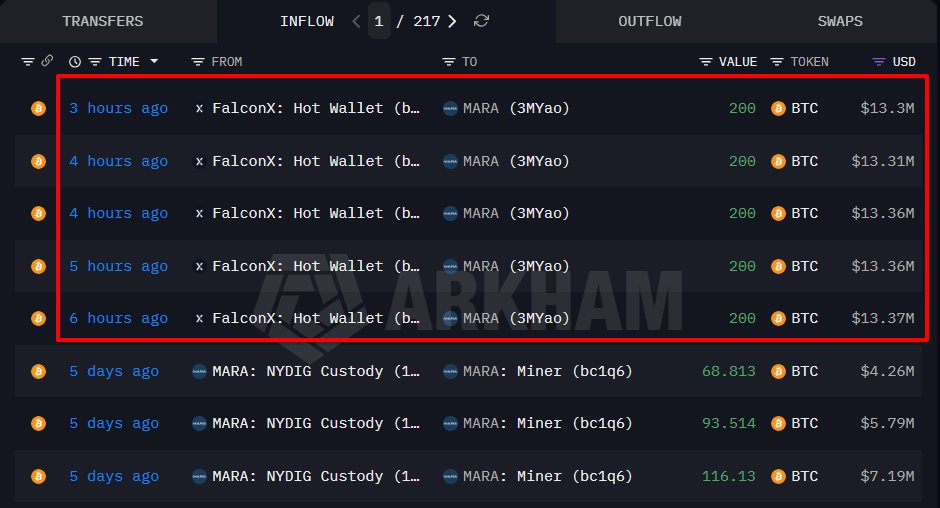
Now, just months later, the company appears to be moving in the opposite direction. Whether this represents a strategic repositioning or a more opportunistic dip-buy remains to be seen, but the signal is hard to ignore. When a major miner starts accumulating again after a billion-dollar exit, the market tends to sit up and take notice.
Bitcoin Finds Its Footing Near $60K
Bitcoin’s own chart has been doing some work of its own. The asset rebounded from lows near $60,000 as selling pressure gradually eased and options markets began unwinding fear positioning.
Volume, open interest, and broader capital flows remain relatively subdued, a signal that the recovery looks more like stabilization than a confirmed trend reversal, but stabilization after that kind of flush is still meaningful.
MARA’s re-entry into accumulation mode lands right in the middle of that transition. The $66.7 million purchase doesn’t move the macro needle on its own, but it reinforces a narrative that is slowly building: the worst of the selling may be behind us.
A Geopolitical Catalyst Shifts the Narrative
The broader market context also matters here. A recently announced agreement between the United States and Iran flipped the market narrative almost instantly, from fear and macro caution to something that looked, at least momentarily, like opportunity.
Traders who had spent months pricing in supply shocks, elevated inflation, and geopolitical instability suddenly had a reason to model a different scenario: easing tensions, reopening trade routes, and a gradual return to normalized economic activity.
Oil tumbled on the news, and crypto became one of the clearest beneficiaries of the rotation that followed. Bitcoin, Ethereum, and a range of altcoins all attracted fresh capital as investors recalibrated their risk exposure.
Santiment data tracked the shift in sentiment as it unfolded in real time, noting elevated social volume and a change in the tone of discussion around Bitcoin’s near-term trajectory.
🥳 The announcement of an agreement between the U.S. and Iran instantly changed the market narrative from fear to opportunity. After months of traders worrying about supply shocks, inflation, and broader geopolitical instability, investors suddenly had a reason to price in the… pic.twitter.com/Co7jxS116i
— Santiment Intelligence (@SantimentData) June 15, 2026
Expectations Are Doing More Heavy Lifting Than Fundamentals
What makes this particular moment interesting and arguably a little precarious, is that much of the rally appears to be running ahead of the fundamentals. Markets tend to do this. They price in scenarios before those scenarios fully materialize, and right now, traders are treating the U.S.-Iran agreement as the first chapter of a broader stability story rather than a one-time headline.
If that narrative holds, the implications are significant. Easing inflation pressure combined with renewed institutional comfort could transform what currently looks like a relief bounce into the early stages of a more sustained bull cycle. But that outcome depends on a lot of moving parts aligning and given how many false dawns the 2026 market has already produced, experienced traders are keeping their expectations measured even as sentiment improves.
What MARA Move Really Signals
MARA’s decision to buy through FalconX rather than through open market activity is itself worth noting. FalconX operates as a prime brokerage for institutional-scale crypto transactions, offering over-the-counter execution that minimizes market impact. Choosing that route suggests the purchase was deliberate and structured, not a reactive trade made in the heat of a price move.
For a company that just liquidated 20,880 BTC at an average of $70,137, buying back at current levels implies a view that Bitcoin at these prices offers value worth re-entering for. Whether MARA is rebuilding for the long term or positioning ahead of an anticipated price recovery, the underlying message is the same: the company is not done with Bitcoin.
The Bigger Picture For Miners
MARA’s moves reflect a tension that many publicly traded miners navigate, the need to manage treasury and operational liquidity against a long-term conviction in Bitcoin’s value. Selling into Q1’s elevated prices made sense from a cash flow and operational standpoint. Re-accumulating now, closer to the $60K-$67K range, suggests the company sees a floor forming, or at least a risk-reward setup worth taking.
For the broader mining sector, this kind of visible accumulation from a major player carries weight. It tells the market that institutional-grade participants are not abandoning their Bitcoin exposure. And in a market that has spent much of 2026 searching for reasons to feel confident, that kind of signal, even at $66.7 million, lands louder than the dollar figure alone would suggest.
Disclosure: This is not trading or investment advice. Always do your research before buying any cryptocurrency or investing in any services.
Follow us on Twitter @nulltxnews to stay updated with the latest Crypto, NFT, AI, Cybersecurity, Distributed Computing, and Metaverse news!