

Bhutan is selling Bitcoin again. On-chain data shows the Himalayan kingdom’s government has transferred 533.2 BTC worth approximately $34.5 million to Binance, with $18.26 million of that amount traceable directly from tagged Bhutan holding addresses.
The move is the latest in a year-long pattern of systematic liquidations that has seen one of the world’s most unusual sovereign Bitcoin holders quietly offload nearly $1 billion worth of the asset and the remaining stack is getting noticeably thin.
According to Arkham Intelligence, Bhutan now holds approximately 1,750 BTC worth roughly $113 million after this latest transfer. What was once a quietly accumulated sovereign treasury has been reduced to a fraction of its former size through a series of deliberate, ongoing sales.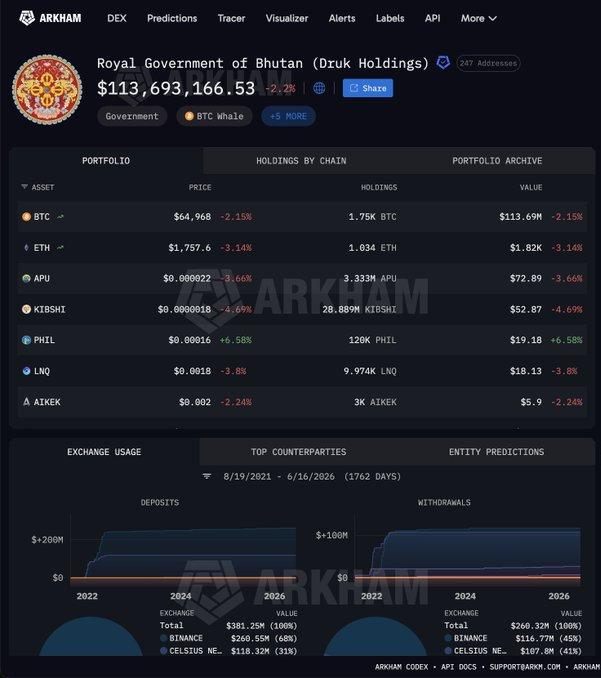
Contents
A Year of Selling at Near-Perfect Timing
The numbers behind Bhutan’s liquidation campaign are striking. EmberCN reports that since June last year, the sovereign entity has sold approximately 10,451 BTC at an average price of $93,738 per coin, generating roughly $979 million in total proceeds across the full distribution cycle.
That average sale price is worth pausing on. Bhutan has been selling into significant strength, exiting at levels well above where Bitcoin spent much of 2023 and early 2024.
Whether that reflects deliberate price timing or simply the mechanical reality of selling into a bull cycle that ran for an extended period, the outcome has been favorable from a revenue standpoint. A sovereign fund that entered Bitcoin mining early and has been exiting methodically near cycle highs is, by most measures, executing a financially coherent strategy.
What the On-Chain Trail Reveals
The current transfer carries a specific on-chain signature that analysts have been tracking. Arkham’s monitoring flagged that Bhutan’s Binance deposit address received a total of $34.61 million in Bitcoin in this latest movement, with $18.26 million confirmed as originating from addresses tagged directly to Bhutan’s known holdings. The remainder appears to have arrived through connected but less directly attributed addresses.
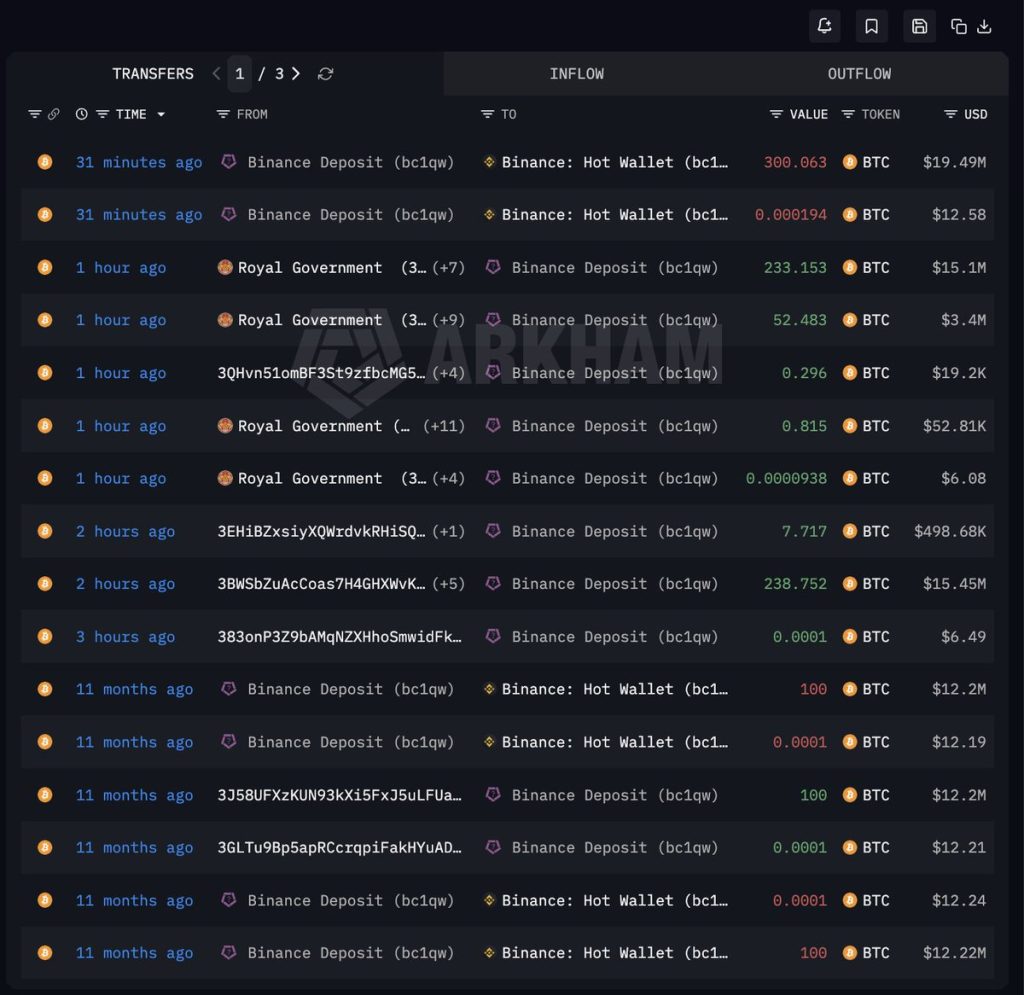
The deposit address routing to Binance is the clearest signal of intent. Sovereign entities holding Bitcoin for long-term strategic reserves do not move funds to exchange deposit addresses, that is a pre-sale action, and the on-chain community reads it accordingly. EmberCN’s analysis characterizes the pattern as continued distribution pressure from one of the largest sovereign BTC sellers currently active in the market.
15 分钟前,不丹王国政府地址把 533.2 枚 BTC ($3452 万) 转进 Binance。
自去年 6 月以来,他们在一年时间里应该是陆续卖出了约 10,451 枚 BTC 套现 $9.79 亿,均价 $93,738。
他们还持有约 1,750 枚 BTC ($1.13 亿)。
地址:https://t.co/5HrauRSpRT… https://t.co/y192QwNOnc pic.twitter.com/b30gQbecI6— 余烬 (@EmberCN) June 17, 2026
Bhutan Remaining Stack and What It Means
With approximately 1,750 BTC worth $113 million remaining, Bhutan’s sovereign Bitcoin position has been reduced to roughly 14% of what the total liquidation volume implies it once held across the full selling cycle. The remaining supply is limited relative to what has already been sold, but the systematic selling pattern shows no sign of stopping.
That remaining $113 million represents real money for a country with Bhutan’s economic scale, and the decision about how quickly to distribute the rest, or whether to hold any as a long-term reserve, will shape how the kingdom’s Bitcoin experiment ultimately concludes. If the same average sale price holds, the remaining 1,750 BTC could generate another $164 million at $93,738 per coin, though actual exit prices will depend on where Bitcoin trades when those sales occur.
The Sovereign Seller Dynamic and Market Pressure
Bhutan occupies a genuinely unusual position in the Bitcoin market. Unlike institutional sellers who typically face scrutiny from shareholders and public investors, or miners who sell to cover operational costs, Bhutan is a sovereign government with discretion over both timing and scale.
That lack of external accountability means the market gets limited forward visibility into when the next transfer will come or how large it will be.
From a market structure perspective, consistent sovereign selling of this magnitude does create background pressure. Ten thousand BTC sold over twelve months at an average of $93,738 represents a real and ongoing supply input into the market.
The transfers arrive in chunks, not in a continuous stream, but the pattern is regular enough that on-chain monitors like Arkham and EmberCN have been able to track and anticipate them with reasonable accuracy.
Where This Fits in the Broader Sovereign Bitcoin Picture
Bhutan’s story is one of the more fascinating in Bitcoin’s sovereign adoption narrative, but it is evolving into something different from the treasury accumulation story that countries like El Salvador have pursued. Rather than building and holding a strategic reserve, Bhutan appears to be in active monetization mode, converting a mining-derived Bitcoin position into fiat revenue at a measured pace.
That is not inherently a negative signal for Bitcoin. Sovereigns entering and exiting positions is part of how any asset class matures into global legitimacy. But with only 1,750 BTC left on the books and a year of consistent selling behind it, the Bhutan chapter of the sovereign Bitcoin story is clearly moving toward its final pages. Whether the kingdom retains any position at all once the current distribution cycle concludes, or exits entirely and books the full proceeds, remains the one question the on-chain data cannot yet answer.
Disclosure: This is not trading or investment advice. Always do your research before buying any cryptocurrency or investing in any services.
Follow us on Twitter @nulltxnews to stay updated with the latest Crypto, NFT, AI, Cybersecurity, Distributed Computing, and Metaverse news!