
A series of bizarre on-chain transactions have turned heads in the crypto community after a combined 107 BTC-value roughly $8,2 million-has been sent to BTC’s infamous burn address, 111111111111111111114oLvT2.
These moves, carried out in five distinct transactions, effectively “burn” the bitcoins forever from circulation triggering lots of speculation about what this is actually and what the higher impact might be.
On-chain monitor SaniExp was one of the first to flag such activity, highlighting both how large and structurally similar these transfers were. The burn address, which is an implausible destination, has been used for checks and balances or funds that must not be recovered historically. However, what differentiates this transfer is its unprecedented scale which begs the questions whether it was an intentional strategic maneuver or perhaps a flaw in operations, If not maybe part of a larger undisclosed mechanism.
🚨🚨🚨 Someone just broadcasted 5 transactions totaling 107 BTC to the Bitcoin "burn address" 1111111111111111111114oLvT2
😢😢 https://t.co/O8qeGjrzG9 pic.twitter.com/oQplxtQgSd— Sani | TimechainIndex.com (@SaniExp) May 26, 2026
This case is particularly interesting due to the lack of explanation. Instead, these transactions amaze you with zero reasoning, unlike an average whale movement or exchange-related flows.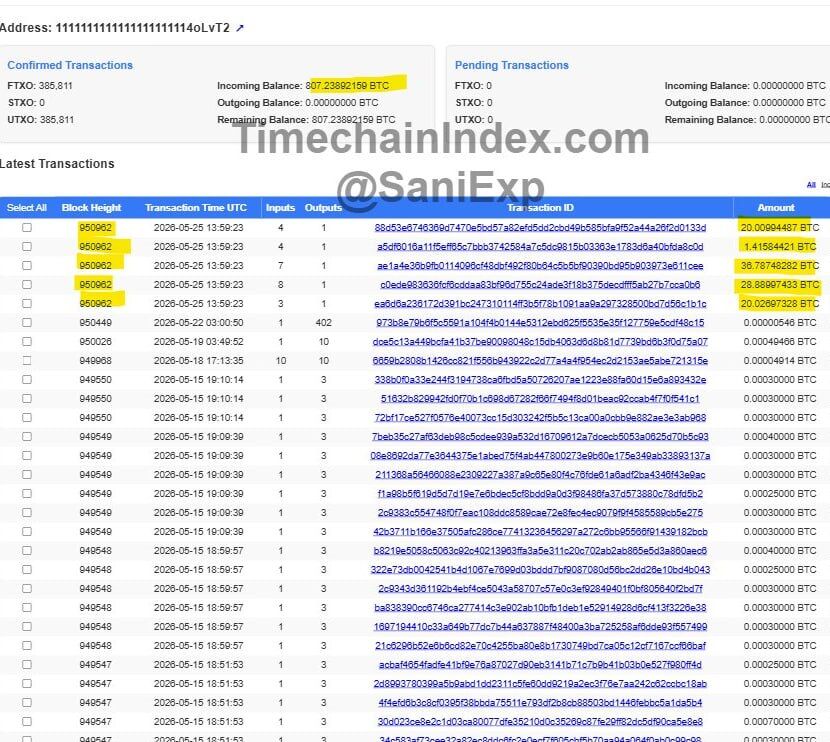 Such ambiguity naturally generates anxiety and intrigue in a market that is already acutely attuned to large capital shifts.
Contents
Possible Mt Gox Connection Emerges
The story becomes more complicated with further investigation. According to blockchain compliance platform AMLBot, more than 100 BTC from the transactions above could be traced back to wallets that were historically connected to Mt. Gox – the shuttered exchange whose long shadow continues to hang over Bitcoin markets even years after its demise.
These funds seem to originate from wallets that have previously received Mt. Gox distributions, according to a report shared by AMLBot. In fact, the inferences drawn from this association may redefine what we claim concerning the burn event, are funds that stagnated for prolonged periods just being cleaned up, or strategic actions taken as a result of security controls, or was it more like synchronized actions around asset management decisions relevant to the elongated recovery processes.
BTC linked to Mt.Gox were recently sent to BTC burn address
More than a 100 BTC were sent to 1111111111111111111114oLvT2 that is used as a burn address. Most of the addresses involved were receiving funds linked to Mt.Gox.
The address on the screenshot got 20 BTC and was… pic.twitter.com/6QrToqyRtI
— AMLBot (@AMLBotHQ) May 26, 2026
The Mt. Gox angle brings in historical weight but also a significant amount of renewed uncertainty. Previously, the length process of repayments from the exchange has influenced liquidity expectations during market cycles. Nonetheless, actions that are tied to these wallets and raise suspicion, especially irreversible ones like burning, naturally garner more press attention.
Wallet Behavior Indicates a Gradual Selling Pressure
Transaction patterns provide a closer look to see more nuanced behavior. A single wallet was responsible for depositing 20 BTC into a gradual liquidation, continuously moving just slices of its holdings onto the Kraken exchange. This pattern indicates a calculated and incremental strategy as opposed to an abrupt or hasty offloading of assets.
That same wallet, however, ended up destroying the other 1.42 BTC that was also in its possession; a tension between profit-taking behavior and asset destruction that is irreversible. That duality is complicated, intertwining traditional financial reasoning with behavior that runs counter to expected market incentives.
These other signals usually indicate either multiple agents working under a joint rubric or one actor employing some kind of strategy on multilayered levels. While the motives remain speculative without confirmation, the behavior shows that on-chain data can expose transaction patterns but leave motivation ultimately ambiguous.
Growing Pressure On Institutional Flows
Outside of the burn event, wider macroeconomic indicators point to increased pressure in Bitcoin investment. Funds investing in digital assets saw $1.3 billion of outflows last week, while Bitcoin witnessed the largest weekly outflow so far 2026
This change of pace indicates diminishing institutional interest, after a prolonged period where institutions were aggressively buying up Bitcoin. Eth is the lone major digital asset with negative year-to-date flows, suggesting capital rotation is in effect. However, Solana retrieves this with its $7.7 million inflow while XRP causes a parting of the ways among investors.
🚨JUST IN: Bitcoin investment products saw $1.3B in outflows last week, the largest weekly bitcoin:native outflow of 2026, while Ethereum became the only major digital asset with negative YTD flows. Solana recorded $7.7M in inflows. pic.twitter.com/shWMaHbzan
— SolanaFloor (@SolanaFloor) May 26, 2026
This behaviour of Bitcoin outflows and Solana inflows is the old money vs new money dynamic. Investors are not necessarily making a wholesale exit from crypto but reallocating into more appropriate assets that fit the changing narratives, risk profiles, and returns.
Bitcoin Risk Index Signals Warning
Swissblock continues the list of ominous signals, reporting that the Bitcoin risk index has jumped to the “high-risk” zone with a score of 33/100. This also illustrates a bigger underlying structure of the market, with May being the end of strong accumulation and transition into institutional distribution.
According to Swissblock analysis: “Each one of the prior two cycles exhibited a very similar degree of destabilization – combined with a steep drop-off in prices of BTC, usually during Q Quadrant (of S-R), each time before they took BTC for New Records in price.” Risk indicators sent out warnings of weakening market conditions well in advance of the ~35% capitulation that took place during that episode.
It is crystal clear:
Every time the Risk Index signals that selling pressure is structurally overwhelming the market, what sits underneath is institutional distribution.
Observe the pattern:
→ High Risk expands
→ ETF flows deteriorateBTC ETFs are still slightly positive in… pic.twitter.com/3chLxdzHej
— Swissblock (@swissblock__) May 25, 2026
Of course, historical analogies cannot assure consecutive outcomes on an identical basis, but rather only position a parametric basis to evaluate parallels.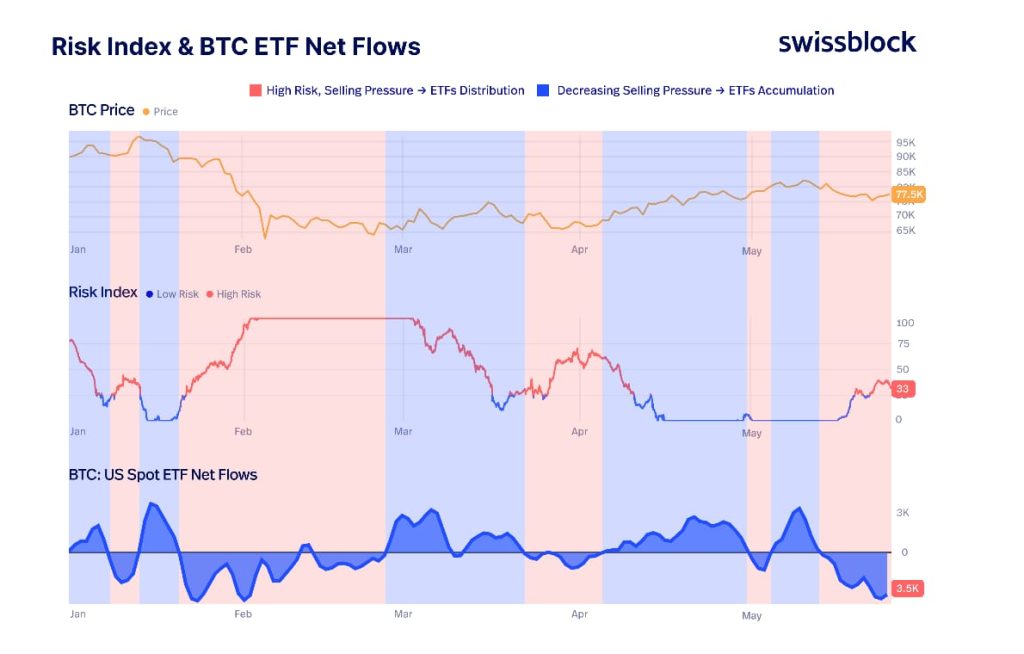 Combined with continued outflows, a rising risk index is a frequent indicator that whales are de-risking, hinting of possibly stronger volatility soon thereafter.
Signals Intersect And Uncertainty Grows
This narrative is complicated and ever-changing when taken in totality. The inexplicable incineration of 100+ BTC adds some unwelcome on-chain randomness, and institutional outflows alongside increasing risk measures highlight the bigger macro pressures at play.
Each one of these signals is manageable by itself. But the convergence raises market sensitivity. Traders and investors are parsing price formations as well as the underlying behaviour, from wallets to capital flows and risk-on indicators.
The most profound is the state of mind across the ecosystem. The green light where optimism and accumulation was once king, has been replaced by caution and scrutiny. Market players are asking more pointed questions: Who is pulling these funds? Why are assets being burned? And what can institutional behavior tell us about the next chapter of the cycle?
For now, no one knows for sure. Those bitcoins are irrevocably incinerated, never to be seen again, carrying their secrets with them. But the ripple effects, across sentiment, strategy and market structure, are just getting started.
In that light, one thing is clear as the crypto market digests these signals: uncertainty is no longer an edge case. This has become the key narrative forming Bitcoin’s next act.
Disclosure: This is not trading or investment advice. Always do your research before buying any cryptocurrency or investing in any services.
Follow us on Twitter @nulltxnews to stay updated with the latest Crypto, NFT, AI, Cybersecurity, Distributed Computing, and Metaverse news!