
The Sui blockchain network is facing increased scrutiny following two consecutive days of mainnet outages, which raises serious questions about the network’s operational reliability at a critical time in its expansion.
The primary communication channel for the network confirmed there were serious outages, forcing the mainnet to suspend activity and disrupt transaction flow.
Such network activity may be paused due to ongoing technical issues, read a status update from the team. The event was designated a “Major Outage” by Sui Status and traced to faults occurring in the settlement mechanisms of its mainnet.
Sui mainnet is currently experiencing a network stall. Network activity may be paused at this time.
The Sui Core team is actively investigating. Updates and incident review will be shared as soon as they are available.
— Sui (@SuiNetwork) May 29, 2026
Block explorers worldwide showed just how bad the outage was during its peak, no new blocks were mined for more than an hour, effectively bringing the chain to a standstill, blocking users from performing transactions. These types of halts highlight the obstacles new networks face, especially when it comes to maintaining security with increasingly complicated and constantly changing tech stack in a network planning to serve as a layer-1 high-performance solution.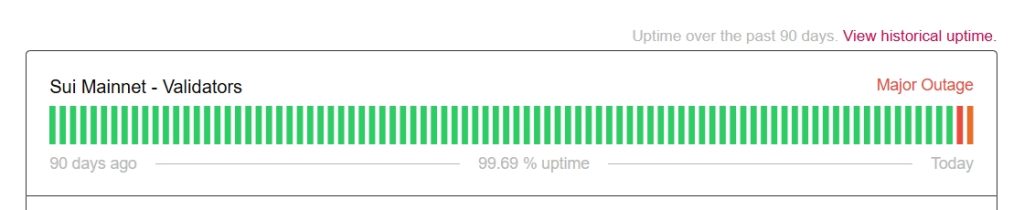
Contents
Initial Outage Tied to Bug in Gas Logic New Release
The first significant outage was on May 28 when the Sui network halted for around five or six hours. One of the incidents was subsequently traced back to a bug in the gas charging logic within the 1.72 network release that had been newly deployed, which caused a crash-inducing error to occur.
Activity on Sui mainnet has resumed after a halt due to a crash bug in the gas charging logic introduced by the 1.72 release. A full incident review will be shared in the coming days.
— Sui (@SuiNetwork) May 28, 2026
This bug affects the foundations on which blockchain naturally operates, namely how transaction fees are processed & calculated. If the gas logic does not work, consensus protocols may fail as validators are unable to consistently process transactions thus halting block production altogether.
Software updates are critical to improving performance and user experience, but with them, there will always be risks attached. But in this case the update seems to have had some pretty nasty unintended consequences that reverberated through the core processes of the network.
It also points out a wider problem around blockchain development, a deployment that behaves as expected in test environments with no value moving, and can react quite differently when live economic activity is taking place.
Second Outage Adds To Growing Stability Concerns Crisis
The second, shorter outage followed on May 29, just one day after the first. While not as deep some of those events were more back-to-back, exacerbating concerns in the community.
Multiple outages in short succession result in more rapid confidence loss than stand-alone ones. As with all developers building on the platform, infrastructure consistency is important; as for users, reliability is a given.
The second outage was shorter but it was nevertheless a reminder the system remained vulnerable nearly two months after that initial breakdown.
Funds Are Safe — Network Recovery Confirms
Regardless of those interruptions, Sui confirmed that regular operations of the full network have resumed and there was no risk to user funds at any point. Most importantly no assets were lost during either down time, a vital source of comfort to both retail consumer and institutional players.
The network’s halting mechanism against an unsafe state operated as intended. Instead of letting your transactions go through when they should not (or a new invalid transit between nodes) it basically held you up until all is back in order.
This method demonstrates a conscious prioritization of security at the expense of uninterrupted uptime, a compromise that most modern blockchains navigate. Sure, outages can disrupt service but protecting users’ assets is the most important.
The Sui team has also promised to publish a detailed post-mortem report in the next few days, which is likely to provide insight into the root causes and preventive measures.
Questions on Reliability As Adoption Grows
These outages mark Sui’s second major downtime in 2026, after reaching around six hours of downtime earlier this January. While broader adoption from both decentralized finance (DeFi) and gaming sectors remains the goal, a growing number of reliability concerns can no longer be ignored by anyone but ardent diehards.
The general idea behind high-performance blockchains, however, is that they generally run near the technical limits, pushing the boundaries of speed, throughput and scalability. The downside of this kind of optimizations is that they can make code more convoluted, and thus lead to increased sensitivity for bugs and edge cases.
The main issue for Sui is managing the fine line between innovation and running a safe operation. With your applications deploying in ever-greater volume and user activity increasing, costs of downtime start to skyrocket. Predictable infrastructure is required by developers, and seamless interactions are expected by users.
Even with a bag in hand, repeated outages can drive the decision of where developers build and what liquidity flows through the ecosystem.
Growing Pains Or Structural Challenge For High-Performance Chains?
But above all, the recent outages bring forward a more general question on what next-gen blockchain design is sacrificing. Are these disruptions the birth throes of something much larger and scalable, or do they highlight systemic weaknesses?
This challenge has historically also faced many ultra-high-performance networks as they first adopted. Fast iterations, constant software updates and difficult-to-execute environments all lead to the situations where bugs are able to get through into live systems.
At the same time, a constant uptime is an important metric that remains vital for long-term success. Rival platforms are constantly improving and reliability, and users have no patience for repeated outages.
The months ahead will prove crucial for Sui. Confidence can only be restored by a clear post-mortem response and strong rectifications, while operations keep running steadily.
The technology has a lot of promise, and the ecosystem keeps expanding; still, reliability is baseline, not a feature in a competitive blockchain space. Given Sui’s aggressive push into DeFi and gaming, the ability to maintain 100% uptime may be an important predictor of how quickly the network can gain traction.
Disclosure: This is not trading or investment advice. Always do your research before buying any cryptocurrency or investing in any services.
Follow us on Twitter @nulltxnews to stay updated with the latest Crypto, NFT, AI, Cybersecurity, Distributed Computing, and Metaverse news!